
Tattoo Styles
A tattoo style is the visual language a design is drawn in: how heavy the lines are, whether it uses color and how shading builds depth. Below, one rose is drawn in 12 styles so you can compare them side by side before choosing one to discuss with your artist.
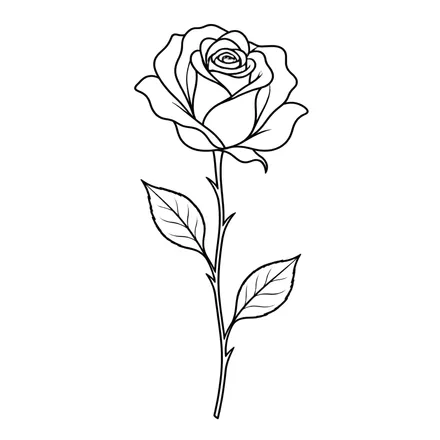
Fine line
Thin, even lines with little or no solid fill.
Size to discuss: Often around 3 in (7.5 cm) — ask your artist what size keeps the detail clear.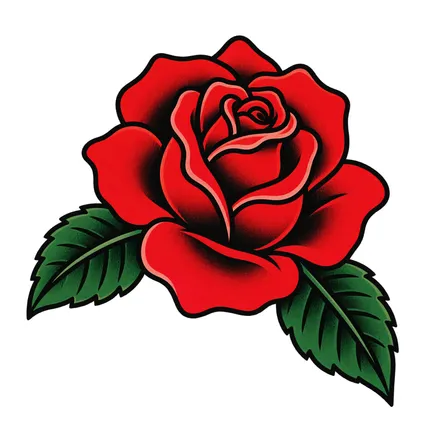
American traditional
Bold black outlines, a few solid colors and simple shading.
Size to discuss: Often around 3 in (7.5 cm) — ask your artist what size keeps the detail clear.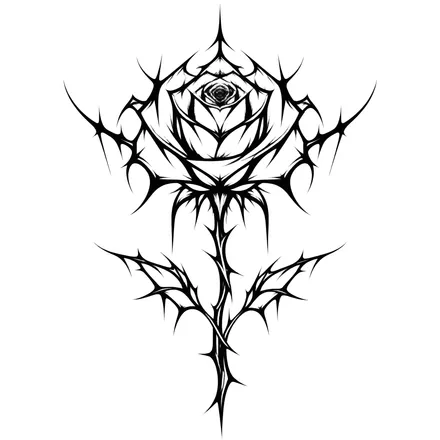
Cybersigilism
Sharp, branching black lines that follow the body.
Size to discuss: Often around 3 in (7.5 cm) — ask your artist what size keeps the detail clear.Describe your own idea
One rose, 12 styles
Each rose below starts from the same idea, a single stem with two leaves. What changes is the line weight, the color and how shading is built. Tap a rose to see what defines the style, or open the styles that have their own page of ideas.
Compare styles at a glance
| Style | Lines | Color | Shading |
|---|---|---|---|
| Fine line | Thin, even | Mostly black or grey | Light or none |
| American traditional | Bold black outlines | A few solid colors | Simple black shading |
| Cybersigilism | Thin, sharp, branching | Black | None |
| Neo-traditional | Bold, varied weight | Rich, wide palette | Layered and detailed |
| Japanese | Bold outlines | Flat color | Simple, stylized |
| Black and grey realism | Few or no outlines | Black and grey | Smooth gradients |
| Blackwork | Heavy black shapes | Solid black | Negative space |
| Tribal | Bold curves and points | Black | Solid fill |
| Minimalist | Few and simple | Usually black | None |
| Geometric | Straight lines and circles | Usually black | Little or dotted |
| Dotwork | Dots instead of lines | Black or grey | Stippled |
| Sketch | Loose, layered | Black or grey | Pencil-like hatching |
Use this table as a quick reference. Most real tattoos sit somewhere between two styles.
How to choose a style
Start with size and placement. Styles built on bold outlines and solid fill, such as American traditional, stay readable at a moderate size, while realism and dense dotwork need more room for their gradients. Think about distance as well: some designs are meant to read from across a room, others reward a close look.
Look at portfolios, too. Most artists specialize, and a fine line artist and a traditional artist will draw the same rose very differently. If you like parts of two styles, say which parts, for example traditional outlines with softer color, and let your artist decide how to combine them.
Try a style on your own idea
Describe a subject, then pick a style. The style is added to your description, and you can remove it at any time.
More tattoo styles
Questions about tattoo styles
What are the main tattoo styles?
Common styles include fine line, American traditional, neo-traditional, Japanese, black and grey realism, blackwork, tribal, minimalist, geometric, dotwork and sketch, plus newer styles such as cybersigilism. Many artists blend two or more.
Which tattoo style holds up best over time?
Bold outlines and solid fill generally keep their shape longer than very fine detail or soft gradients, which can soften over the years. Placement, aftercare and the artist's technique matter too, so ask your artist about your design.
Can I combine two styles?
Yes. Neo-traditional, for example, builds on traditional outlines with more detail and color. Tell your artist which parts of each style you want to keep.
Can the generator copy a specific artist's style?
No. The styles here are broad traditions anyone can work in. Please don't ask for a copy of a living artist's work; bring a reference to an artist and let them draw it their way.
Are the previews and artist brief free?
You get 3 free previews on this device: 1 right away and 2 more after you verify your email. They're shared across the site. Lettering previews and the artist brief are free.
Design reference to discuss with your artist — not a final tattoo or healed result.