
Tattoo Pain Map
Pain levels are the same for both body shapes. In the 2020 survey, men and women reported similar pain during tattooing.
- Often more painful
- Middle
- Often less painful
- * Not rated in the study
Ribs
Often more painful
Skin over the ribs is thin and stretches with every breath, and the bone is close beneath it.1
Study level: High
All body areas
Often more painful
Front · Back
Thin skin lies directly over bone across most of the head and face, and the area has many nerve endings.1
Study level: High
Front
The skin of the neck is thin and moves a lot, and the front sits close to the throat and collarbones.1
Study level: High
Front
The collarbone sits just under thin skin with little padding, so the needle works close to bone.
Not rated in the study
Front
The chest muscle gives some padding, but the skin thins toward the breastbone and the armpit.1
Study level: High
Front
The breastbone lies directly under a thin layer of skin in the center of the chest.34
Not rated in the study
The study rates the chest as a whole in its highest group, and both industry charts we checked also rate the sternum high.
Front
Skin over the ribs is thin and stretches with every breath, and the bone is close beneath it.1
Study level: High
Front
Padding varies a lot from person to person, and the skin stretches as you breathe.134
Study level: High
The industry charts we checked rate the stomach closer to the middle.
Front
The armpit has thin, sensitive skin, and large nerves pass close by.1
Study level: High
Front
The inner thigh has softer, thinner skin and is more sensitive than the outer thigh.1
Study level: High
Front · Back
The ankle bones sit just under thin skin, with tendons close by.
Not rated in the study
Back
The back of the neck and the top of the shoulders have thinner skin over the upper spine and the trapezius muscle.1
Study level: High
Back
The spine runs directly under the skin along the center of the back.
Not rated in the study
Back
The skin behind the knee is thin and creased, with nerves and blood vessels close to the surface.
Not rated in the study
Middle
Front
The hip bone sits close to the skin at the front, while the outer hip has more padding.
Not rated in the study
Front · Back
The point of the elbow is bone just under the skin, and the inner crease has thin skin.134
Study level: Mid
Both industry charts we checked rate the elbow higher than the study does.
Front
Skin over the wrist is thin, with tendons and small bones close to the surface.
Not rated in the study
Front · Back
There is little padding over the bones and tendons of the hand, and the skin moves constantly.134
Study level: Mid
Both industry charts we checked rate hands higher than the study does. Hand tattoos also tend to fade sooner.
Front
The kneecap and the front of the shin are bone directly under thin skin.134
Study level: Mid
Both industry charts we checked rate the knee higher than the study does, and one puts the shin among the most painful areas.
Front · Back
The top of the foot has thin skin over many small bones and tendons.134
Study level: Mid
Both industry charts we checked rate the feet higher than the study does.
Back
Muscle covers most of the upper back, but the shoulder blades and spine sit closer to the surface.34
Not rated in the study
The industry charts we checked put the back in the low-to-middle range, with the shoulder blades and spine rated higher.
Back
The lower back has more padding at the sides and bone closer to the surface in the middle.
Not rated in the study
Back
The calf muscle gives good padding, though the skin is thinner toward the ankle and shin.134
Study level: Mid
Industry charts disagree here: one gives the calf its top score while calling it often less painful, and the other puts it near the middle.
Often less painful
Front · Back
The outer shoulder is covered by a thick muscle, with more padding over the bone.1
Study level: Low
Front
The outer upper arm has muscle and padding over the bone.14
Study level: Low
One industry chart we checked rates the inner bicep higher than the outer arm.
Front · Back
The outer forearm has muscle and thicker skin; the inner forearm is thinner, especially near the wrist.1
Study level: Low
Front
The outer thigh has thick muscle and padding, and it is usually described as one of the easier areas.1
Study level: Low
Back
The buttocks have thick padding of muscle and fat over the bone.
Not rated in the study
Back
The back of the upper arm has muscle and padding, with the bone well beneath.1
Study level: Low
Back
The back of the thigh has thick hamstring muscles over the bone, though the skin grows thinner toward the back of the knee.
Not rated in the study
Where a tattoo goes changes how much it tends to hurt. Tap an area on the front or back view to see whether it is usually described as more or less painful, what sits under the skin there, and where that rating comes from. There are no 1–10 scores here: the research is thinner than most charts suggest.
How we rated each area
Each area falls into one of three groups. For 18 areas, the group comes from the only published study we found that rates tattoo pain by body location: a 2021 pilot study in which researchers interviewed six tattoo artists and two customers and sorted areas into high, mid and low sensitivity. That is a small sample, so treat it as a starting point.
Areas the study did not name are grouped by what sits under the skin, such as bone close to the surface or thick padding, and are marked Not rated in the study. Where the industry pain charts we checked disagree with the study, the area says so. Those charts use their own 1–10 scores without a published method, so we quote them as examples rather than evidence.
What tattoo pain feels like
Most people describe a mix of sensations rather than one kind of pain. Outlining often feels like a sharp scratch or sting. Shading and color packing, where the needle passes over the same skin again and again, tend to feel more like burning or a graze. Close to bone, many people notice a strong vibration. As a long session goes on, the skin gets tender and a dull ache can build.
In the 2020 survey described below, about one in five people said the pain spread beyond the area being tattooed, and this was reported more often for arm tattoos. Afterward, the tattooed skin is usually sore for a while, a bit like a sunburn.
What else changes how much it hurts
A 2020 survey of 1,092 tattooed adults in Poland asked people to rate their pain from 0 to 10. On average, pain during tattooing was rated at about 4.3 to 4.5, and men and women reported similar pain during the session; women reported slightly more pain right afterward. Longer sessions, feeling stressed and more bleeding all went along with higher pain ratings. The survey did not compare body areas, and everyone feels pain differently.
Planning a session around pain
If pain worries you, talk to your artist about splitting a large piece into shorter sessions and agreeing on breaks. Eat beforehand and get a good night of sleep. This page is general information, not medical advice: if you have a health condition, take medication or are thinking about numbing products, ask a doctor or pharmacist first.
Use this chart
You are welcome to share this chart. Download the PNG or copy the embed code below, and please keep the link back to this page so readers can see the sources.
Download chart (PNG)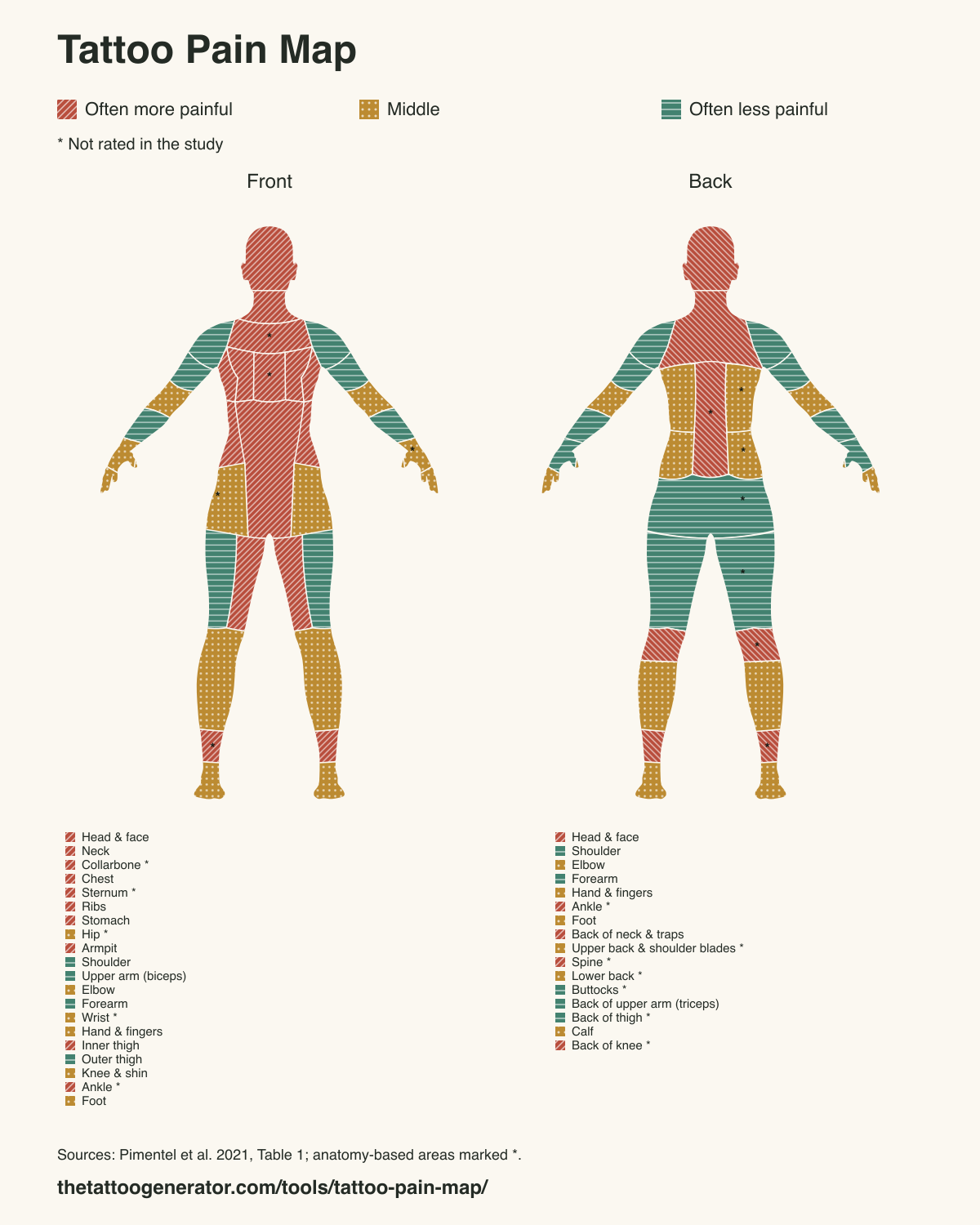
Questions
Where does a tattoo hurt the most?
Areas where bone or dense nerves sit close to thin skin, such as the ribs, sternum, spine, armpit, head and ankles, are usually described as the most painful. In the 2021 interview study, the head, neck, chest, armpits, ribs, stomach, groin and inner thigh were rated highest.
Where does a tattoo hurt the least?
Areas with more muscle or padding, such as the outer shoulder, upper arm, forearm and outer thigh, were rated lowest in the 2021 interview study. The buttocks are also well padded.
Do tattoos hurt more for women or men?
In a 2020 survey of 1,092 people, men and women reported similar pain during tattooing. Women reported slightly more pain right after the session.
Does a longer session hurt more?
In the same survey, longer sessions went along with higher pain ratings. Splitting a large piece into shorter sessions is a common way to manage that; ask your artist.
Is this medical advice?
No. It is general information to help you plan. If you have a health condition, take medication or want to use numbing products, ask a doctor or pharmacist.
Sources
- Pimentel D, Kalyanaraman S, Fillingim R, Halan S. The Effects of VR Use on Pain Experienced During a Tattoo Procedure: A Pilot Study. Frontiers in Virtual Reality 2021;2:643938. doi:10.3389/frvir.2021.643938 — Accessed 2026-10-25
- Witkoś J, Hartman-Petrycka M. Gender Differences in Subjective Pain Perception during and after Tattooing. Int J Environ Res Public Health 2020;17(24):9466. doi:10.3390/ijerph17249466 — Accessed 2026-10-25
- Removery. Tattoo Pain Chart: Pain Level of Tattoo by Body Part (updated 2024-04-08) — Accessed 2026-10-25
- Saniderm. How Much does a Tattoo Hurt? Tattoo Pain Chart (updated 2023-01-16) — Accessed 2026-10-25
Design reference to discuss with your artist — not a final tattoo or healed result.